PRICE DROP Variable Frequency Drive (VFD/VSD) — Single Phase 240V Input — Prices reduced 21 August 2026 900+ products, most now 15% lower

Variable Frequency Drive (VFD/VSD) — Single Phase 240V Input
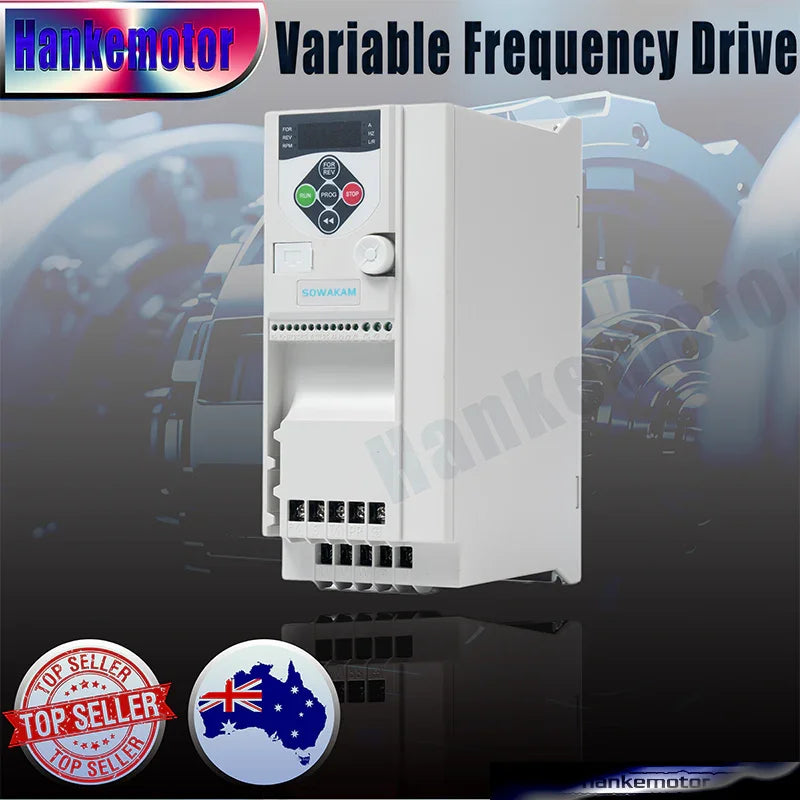
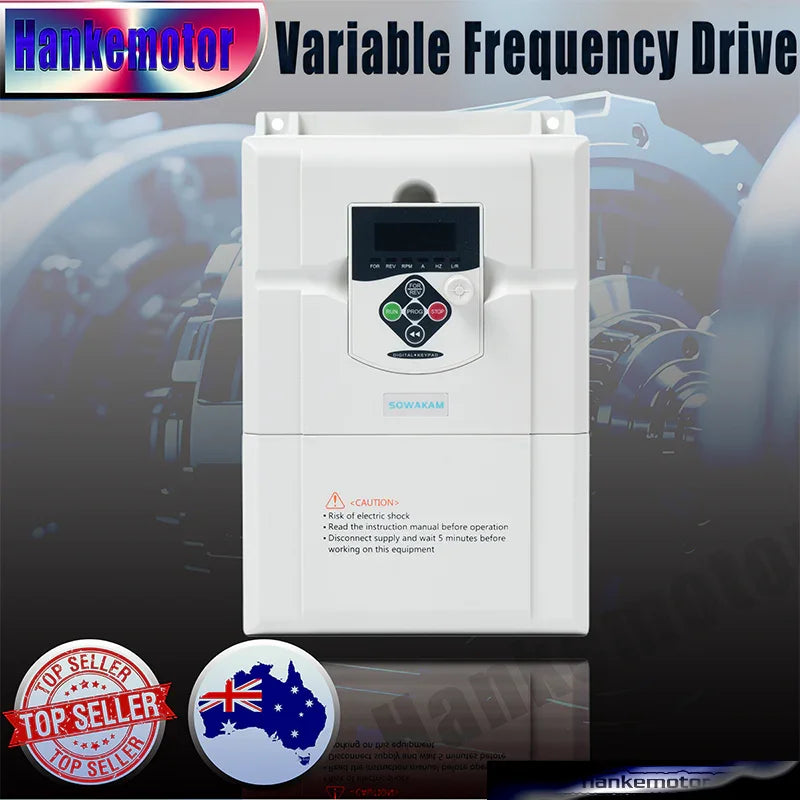
A Variable Frequency Drive (VFD) — also called a VSD or inverter drive — converts single-phase 240V power into variable-frequency three-phase output, letting a three-phase motor run without a dedicated three-phase connection. HankeMotor stocks 10 models, 0.75kW to 37kW.

FilterAll 10 results
Sort by Featured

What Does a Variable Frequency Drive (VFD) Actually Do?

A Variable Frequency Drive (VFD) — also called a VSD (Variable Speed Drive) or inverter drive — converts a standard single-phase 240V household or workshop supply into a variable-frequency three-phase output, letting a three-phase induction motor run without its own dedicated three-phase electrical connection. The VFD controls motor speed by adjusting the output frequency, typically across a 0–600Hz range depending on the model: at 50Hz the motor runs at its nameplate RPM, and at 25Hz it runs at roughly half speed. Beyond speed control, a VFD also provides soft-start, ramping the motor up gradually instead of drawing full inrush current at switch-on — reducing mechanical stress on belts, bearings and couplings. The practical result: a 415V-rated three-phase motor — from a small 0.75kW bench tool to a large 37kW industrial drive — can run from a standard Australian single-phase supply, without the cost of installing three-phase infrastructure.

Two Drive Types We Stock — Which One Do You Need?

SW100 / SW200 Series (G4)
Our most popular range — 0.75kW to 18.5kW
✓ Compact, budget-friendly single-to-three-phase drive
✓ Best for direct motor speed control on workshop machinery
✓ Output frequency 0–600Hz
⚠ Motor-only output — see restrictions below
Commercial-grade
Fulinn BD600
Currently stocked at 7.5kW / 11HP
✓ Factory-configured for 240V Australian input
✓ Full-featured industrial VFD, broader application range
✓ 2-year replacement warranty (vs 1-year on G4 series)
Higher spec for demanding continuous-duty use

Not sure which one fits your machine? Check the exact model spec sheet on each product page — current draw, dimensions and warranty terms differ between the two ranges.

Sizing Reference — SW100/SW200 (G4) Series

1.5kW model
Rated current: 4A
2.2kW model
Rated current: 5A
5.5kW model
Rated current: 13A
11kW model
Rated current: 25A

Other sizes (0.75kW, 3.7kW, 7.5kW, 15kW, 18.5kW) are in stock — exact current draw is listed on each product page.

Sizing rule (per manufacturer guidance): for a light, intermittent load, match the drive to the motor's own kW. For a heavy or continuous-duty load (air compressor, conveyor, pump), size up — as a guide, the manufacturer's own example pairs a 0.75kW heavy-duty motor with a 1.5kW drive. When in doubt, size up rather than down; an undersized drive on a continuous-duty load can overheat.

What Is a Single-Phase VFD Used For?

Workshop machinery: lathes, milling machines, bandsaws — run existing three-phase machines from a single-phase shed supply
Air compressors: soft-start reduces startup stress on piston and screw compressors
Irrigation pumps: variable speed matches flow to demand, reducing energy use
Conveyor belts: adjustable speed for production lines and packaging
Exhaust fans and air blowers: speed control reduces noise and energy at partial load
Australian Market Warning — 240V vs 220V Imports
Many VFDs sold on eBay and AliExpress are rated for 220V input (European and Chinese standard), not 240V (Australian standard). Running a 220V-rated unit on 240V supply increases internal component stress and heat over time. Every drive we stock — both the G4 series and the Fulinn BD600 — is specified for 240V Australian input.

 When Should You NOT Buy a Single-Phase VFD?

On the SW100/SW200 (G4) series specifically:
Motor-only output: these drives can power an AC induction motor directly, but cannot supply three-phase power to any other equipment. Do not wire the output (U/V/W) into a three-phase distribution board or other electrical devices.
No contactor or relay between drive and motor: switching the motor circuit with a contactor, relay, or circuit breaker while the drive is running can cause an over-current fault and damage the unit.
Capacitor-run single-phase motors cannot use a VFD: if your motor has start/run capacitors, it's a single-phase motor — a VFD (of either range) only drives three-phase induction motors.
Motor above 22kW: a standard single-phase household or workshop supply typically cannot source enough current — talk to us about three-phase infrastructure options instead.

Single Phase 240V to Three Phase — How the Voltage Works

Most Australian three-phase motors are rated at 415V line-to-line (star/Y connection) or 240V line-to-line (delta/△ connection) — check your motor's nameplate for both ratings. A single-phase VFD with 240V input produces three-phase output at approximately 240V. If your motor is dual-rated 415V(Y)/240V(△), reconnect it in delta configuration at the terminal box so it draws 240V and runs at full rated power. Not sure which connection your motor supports? Send us the nameplate photo and we'll confirm before you buy.

Questions? Call 0401 634 280 or email hankemotors@gmail.com
Our Glen Waverley team can match you with the right drive for your motor and application.

Variable Frequency Drive FAQ

What is the difference between a VFD and a VSD?
VFD (Variable Frequency Drive) and VSD (Variable Speed Drive) are the same device in Australian industrial use. Both control motor speed by varying the frequency and voltage of the AC supply to the motor. "Inverter drive" is another common term for the same product.
Can a single phase VFD run a 415V three phase motor?
Yes. Reconnect the motor in delta (△) configuration at the terminal box so it accepts 240V three-phase input. All standard IEC-frame motors with a 6-terminal box support star/delta reconnection. The VFD outputs three-phase at approximately 240V from a single-phase 240V supply, matching the delta voltage of a standard 415V (star) rated motor.
What size VFD do I need for my motor?
Select a VFD rated at minimum 1.2× your motor's nameplate kW. For continuous-duty applications like air compressors and pumps, size up one model — for example, a 2.2kW motor on a compressor should use a 3.7kW VFD. This prevents thermal overload during extended full-load operation.
Do HankeMotor VFDs work on Australian 240V power supply?
Yes. Our Folinn H-series drives are factory-configured for Australian 240V single-phase input. Many cheaper VFDs on eBay and AliExpress are rated for 220V (European and Chinese standard) and run hot on Australian 240V supply. Always check the input voltage specification before purchasing any VFD.
Why does a single phase VFD draw so much current?
Single-phase input current is roughly double the equivalent three-phase input current at the same motor load. A 3.7kW VFD on single-phase draws approximately 28A, requiring a dedicated 32A circuit. A 1.5kW VFD draws approximately 12A, which fits a standard 15A GPO circuit. Always calculate your single-phase input current before installing, not just the motor nameplate current.
Can a VFD be used with a single phase capacitor-run motor?
No. VFDs are designed for three-phase induction motors only. Capacitor-run single-phase motors (most common shed compressor pump motors and single-phase power tool motors) cannot be driven by a VFD. If your motor has a start and run capacitor, it is a single-phase motor and needs a different speed control solution.