Side Channel Ring Blowers | 0.25kW–22kW for Blowing and Suction Applications
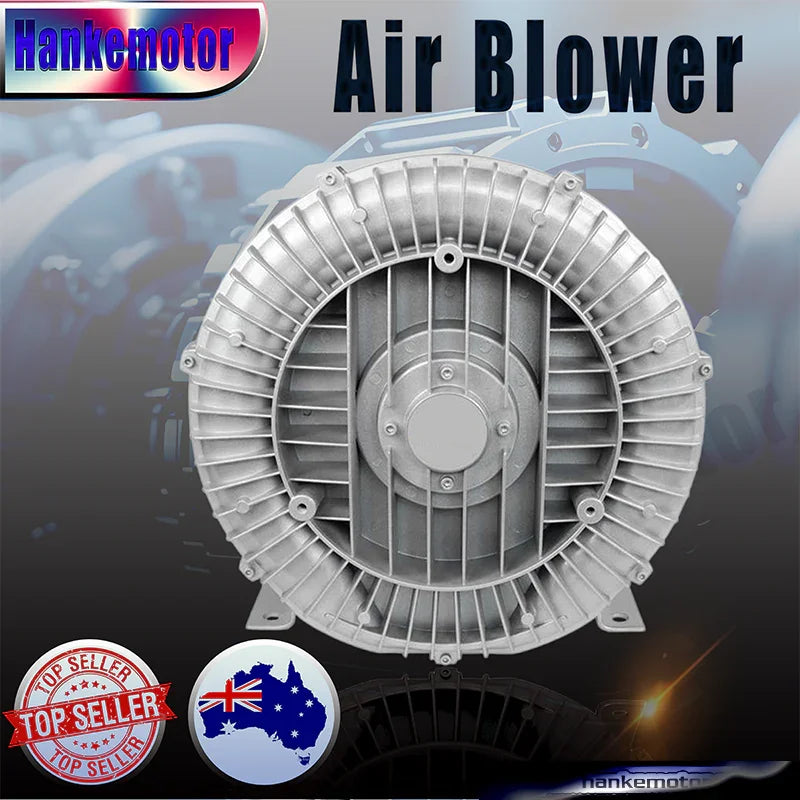
Need continuous airflow or suction, but not the high pressure of an air compressor? A side channel ring blower is designed for applications that need steady low-pressure air, vacuum suction or aeration over long running periods.

HankeMotor supplies 240V single-phase and 415V three-phase ring blowers for aquaculture, wastewater aeration, pneumatic conveying, vacuum hold-down, packaging lines, dust collection assist and industrial air movement. These units are also commonly called vortex blowers, regenerative blowers, side channel blowers or high pressure air blowers.

The key is choosing the right blower by airflow, pressure and power supply. A fan moves large air volume at very low pressure. A compressor creates high pressure air. A ring blower sits between the two, giving continuous airflow with higher pressure than a fan and lower pressure than a compressor.

Filter13 - 17 of 17 results
Sort by Best selling

HankeMotor stocks vortex (regenerative) ring blowers from 0.25kW to 22kW, in both single phase 240V and three phase 415V. All units are direct-drive with no belts or gearbox, delivering high-pressure, low-volume air for continuous industrial duty. Dispatched from Glen Waverley, Victoria with fast Australia-wide shipping.

What Is a Vortex Ring Blower?

A vortex (regenerative) ring blower moves air using a non-contact impeller that regenerates pressure on each revolution. Unlike a standard fan or centrifugal blower, it delivers high static pressure at relatively low airflow — making it suited to applications where you need to push or pull air through resistance, not just move large volumes at low pressure. There are no wearing contact parts, so they run continuously without lubrication or regular maintenance.

Range Overview

0.25kW
48m³/h · single phase 240V
0.75kW
150m³/h, 21kPa · single or three phase
1.1kW
220m³/h, 24kPa · single or three phase
2.2kW
single or three phase
3.7–18.5kW
three phase 415V only
22kW
~2050m³/h · three phase 415V, our largest unit

Exact airflow, pressure and noise figures vary by model — check the individual product page for the full spec sheet before ordering.

Single Phase vs Three Phase: Which Do You Need?

If your workshop or site has 240V single-phase power only, HankeMotor stocks single-phase ring blowers across six power points: 0.25kW, 0.37kW, 0.75kW, 1.1kW, 1.5kW and 2.2kW — covering most small-to-medium aeration, aquaculture and conveying applications without needing three-phase power.

For applications above 2.2kW, HankeMotor's larger units (3.7kW and up, to 22kW) are three-phase 415V only. A variable frequency drive (VFD) cannot substitute for three-phase supply at these power levels — the motor itself requires three-phase input. Contact us on 0401 634 280 to confirm your power supply and the right model before ordering.

How to Choose the Right Ring Blower

Choose a ring blower by matching the airflow, pressure and voltage to your application. Do not select by motor kW alone — two blowers with similar power ratings can behave differently depending on pressure, suction load, pipe length and restriction.

Aquaculture or pond aeration: choose enough pressure to overcome water depth and diffuser resistance
Wastewater or septic aeration: select a continuous-duty blower with suitable ventilation and inlet filtration
Pneumatic conveying: allow extra pressure margin for bends, filters and long pipe runs
Vacuum suction or hold-down: match the blower to the vacuum area, hose size and expected air leakage
Dust collection assist: use a ring blower only where low-pressure continuous air is suitable

If you are replacing an existing blower, check the nameplate for kW, voltage, airflow, maximum pressure, suction pressure and port diameter before ordering.

Ring Blower vs Air Compressor: Key Differences

A ring blower is not a replacement for an air compressor. Compressors produce high pressure (typically 6–12 bar / 90–175 PSI) at lower continuous flow; ring blowers produce low pressure (typically 15–70kPa / 2.2–10 PSI) at continuous high flow. If you need to run a spray gun, impact wrench or pneumatic cylinder, you need a compressor. If you need continuous low-pressure air for aeration, conveying or vacuum, a ring blower is the right tool.

Can ring blowers run 24/7?

Yes. Vortex ring blowers are rated for continuous duty. The non-contact impeller design means there is no mechanical wear from metal-to-metal contact. Service intervals are minimal: check the inlet filter every 3–6 months and ensure ventilation clearance around the unit. Most units in aquaculture and sewage treatment applications run for years between service events.

Are ring blowers loud?

All ring blowers produce noise — the impeller generates a consistent tonal hum at operating frequency, and noise increases with motor size. For installations near offices or noise-sensitive areas, mount the blower on rubber anti-vibration mounts and use flexible inlet/outlet hose rather than rigid pipe connections.

Need help matching a blower to your application? Call 0401 634 280 or email hankemotors@gmail.com
Stock held at Unit 1, 28 Aristoc Road, Glen Waverley VIC 3150

Related: Air Compressors | Variable Frequency Drives | Single Phase Electric Motors

Frequently Asked Questions

What is the difference between a ring blower, fan and air compressor?
A fan moves a large volume of air at very low pressure. An air compressor produces high-pressure compressed air for tools, spray guns and pneumatic cylinders. A ring blower sits between the two, producing continuous low-pressure air or suction for aeration, vacuum, conveying and industrial airflow applications.
What is a side channel blower used for?
Side channel blowers are used for aquaculture aeration, wastewater treatment, pneumatic conveying, vacuum suction, packaging equipment, dust collection assist, drying, cooling and industrial process air. They are suitable where continuous airflow or suction is required, but compressed air pressure is not needed.
Can a ring blower run 24/7?
Yes, ring blowers are designed for continuous-duty operation when installed correctly. The blower should have clean inlet air, enough ventilation around the motor, suitable pipe sizing and an inlet filter where dust is present. Over-restriction, blocked filters or poor cooling can shorten service life.
Should I choose a 240V or 415V air blower?
Choose a 240V single-phase blower if your site only has standard single-phase power and the required airflow is within the available model range. Choose a 415V three-phase blower for higher power, larger airflow, heavier duty or industrial installations. Always check the available power supply before ordering.
Can the same blower be used for suction and blowing?
Many side channel ring blowers can be used for either positive pressure blowing or vacuum suction, depending on which port is connected to the system. The blower must still be matched to the required airflow, pressure, suction load and pipe restriction.
How do I choose the correct blower size?
Check the required airflow, pressure or suction, voltage, duty cycle, pipe length and restriction. For aeration, consider water depth and diffuser resistance. For conveying or vacuum use, consider hose size, bends, filters and leakage. If replacing an old unit, match the nameplate details before selecting a new blower.